2026 Midyear Outlook: What’s Next for Markets?

The first half of 2026 was shaped by market-moving headlines. The conflict in the Middle East was the most significant story, triggering a short-term market sell-off. But investors also focused on the Supreme Court’s decision that the mechanism by which the Trump administration implemented last year’s tariffs was illegal, increased scrutiny on AI infrastructure spending and the ability to earn a return on it, and a transition of Fed leadership from Jerome Powell to Kevin Warsh.
Despite the concerns and uncertainty, global markets closed higher as strong fundamentals supported markets—as they always do. In this case, those strong fundamentals were evident in phenomenal earnings growth from corporate America. First-quarter earnings growth for the S&P 500 came in over 27 percent, compared to analyst estimates at the start of the quarter for growth of just under 14 percent. That result is impressive in any environment and particularly encouraging given the challenges companies have faced over the past year.
So, will the remainder of 2026 be more of the same as investors navigate short-term headlines and long-term fundamentals? Let’s take a closer look.
Market Themes to Watch
My colleagues at LPL have identified four themes that could impact headlines and influence markets over the next several months:
Resource nationalism is influencing how capital is allocated and geopolitical relationships, with the conflict in the Middle East putting a spotlight on where important resources come from.
Midterm election years have historically led to increased market volatility leading up to the election due to elevated uncertainty about the future path of policy. With the House and the Senate hanging in the balance, this year is unlikely to be any different.
The AI investment story is entering its next phase. Companies with a first-mover advantage in infrastructure investment have driven markets. Moving forward, there is expected to be continued scrutiny over the ability to earn a return on this investment and who the ultimate beneficiaries will be.
The Kevin Warsh era at the Fed has begun. He will likely have a brief honeymoon as he inherits a difficult geopolitical landscape and a persistently high inflation backdrop.
While these themes are likely to dominate headlines, investors should remain focused on the economic and earnings backdrop that ultimately drives long-term market returns.
Slow Growth for the Economy, Strong Growth for Earnings
From an economic perspective, there are certainly concerns to monitor. While inflation and Fed policy remain important variables, solid job growth and resilient consumer spending should support continued, albeit slower, economic expansion. After all, slow growth is still growth.
Against that backdrop, corporate America should continue to deliver strong earnings growth. Consensus estimates for the S&P 500 are for 24 percent growth for full-year 2026. Equally as encouraging for investors is that the 493 non-Magnificent Seven stocks in the index are expected to grow 20 percent for the full year, according to J.P. Morgan Asset Management. This is an important inflection point for investors, as market returns have relied heavily on the earnings contribution of the biggest names in the index over the past several years. If broad earnings growth momentum continues, it should provide a foundation for markets over the longer term.
Improving fundamentals are key to a sustainable rally. There is still a lot of excitement around AI, the SpaceX (SPCX) IPO, and large-cap growth, which is understandable. But the rest of the market trades at more attractive valuations, and fundamentals are improving. Historically, attractive valuations paired with improving fundamentals have created favorable conditions for investors.
The result has been a year of "stealth diversification." Large-cap value has outperformed growth, small-caps have outperformed large-caps, and international has continued to outperform just as we saw in 2025.
Keys to the Second Half
As illustrated in LPL’s 2026 Midyear Outlook,* the LPL Research team takes a similar big-picture view, providing valuable insights from their macro and asset class experts. Here are a few of the team’s key takeaways:
Economy. The U.S. economy is likely to continue to grow over the second half of the year but at a slower rate. Hundreds of billions of dollars in AI spending will power strong business investment. This growth should offset weakness in housing and other rate-sensitive parts of the economy.
If geopolitical tensions do subside, led by a resolution in the Middle East that fully reopens the Strait of Hormuz, inflationary pressure could ease. At the same time, subdued growth in job creation should be enough to support resilient consumer spending given the ongoing wealth effect.
Stocks. The trajectory of stocks during the second half will likely depend on two factors:
Much like the economy, an improving geopolitical backdrop that reduces headline risk should allow equity markets to move higher.
Earnings will need to do the bulk of the work in the second half. Corporate America’s resilience in the face of numerous headwinds has led to full-year 2026 estimates rising 10 percent. For reference, in a normal year, estimates have declined 3 percent at this point in the year.
Progress between the U.S. and Iran as well as the ability of companies to deliver on earnings expectations will determine the magnitude of any moves higher or lower for stocks. Stocks should be able to continue to grind higher, but diversification will be important to portfolio construction to navigate the uncertain macro backdrop.
Bonds and cash. With the Fed unlikely to lower rates over the remainder of the year, yields on the 10-year U.S. Treasury bond are expected to be range-bound between 4.00 percent and 4.50 percent. In this scenario, income will likely be a key driver of bond returns.
The best way to capture this opportunity is through core bonds, as opposed to the riskier, lower-credit areas of the market where spreads are historically tight. A longer-term opportunity exists in slightly extending duration to lock in higher yields on the assumption that eventually the Fed will return to lowering interest rates as inflation moves back down toward its 2 percent target.
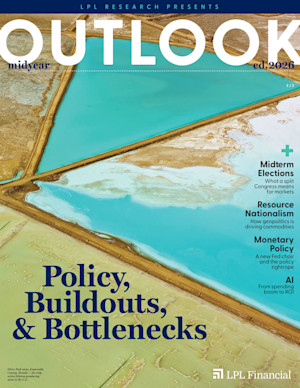
LPL RESEARCH PRESENTS
2026 Midyear Outlook: Policy, Buildouts, & Bottlenecks
Get insights and analysis on the key themes driving markets in the second half of the year.
Opportunities Ahead
As we have seen over the past 18 months, headlines can challenge consensus views in the short term. The remainder of 2026 is unlikely to be different. But as we have also learned in the past, no matter what is happening on the surface, opportunities will present themselves amid the dislocation. The key is finding them.
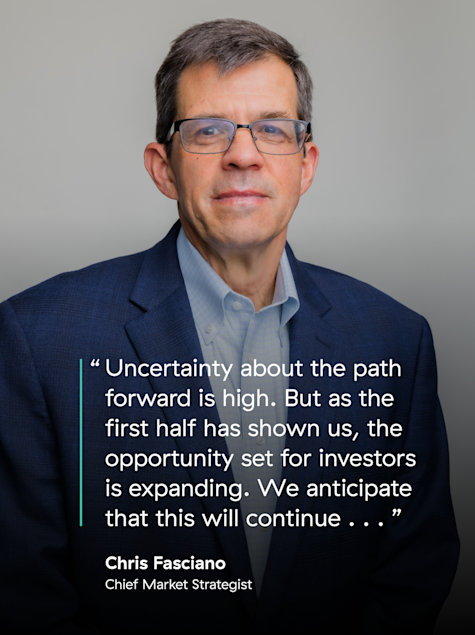
Risks always exist. Uncertainty about the path forward is high. But as the first half has shown us, the opportunity set for investors is expanding. We anticipate that this will continue. Our goal as always will be to focus on long-term investment objectives and construct well-diversified portfolios that meet them.
For more insights into what’s ahead for the economy and markets over the remainder of the year, check out the LPL Research 2026 Midyear Outlook, available here.
*This material has been prepared by LPL Financial LLC (“LPL Financial”), a registered investment adviser and member of FINRA/SIPC. LPL Financial is an affiliate of Commonwealth Financial Network (“Commonwealth”), a registered investment adviser and member of FINRA/SIPC. Commonwealth and LPL Financial are under control of a common parent company.

The information on this website is intended for informational/educational purposes only and should not be construed as investment advice, a solicitation, or a recommendation to buy or sell any security or investment product. Please contact your financial professional for more information specific to your situation.
Certain sections of this commentary contain forward-looking statements that are based on our reasonable expectations, estimates, projections, and assumptions. Forward-looking statements are not guarantees of future performance and involve certain risks and uncertainties, which are difficult to predict. Past performance is not indicative of future results. Diversification does not assure a profit or protect against loss in declining markets.
The S&P 500 Index is a broad-based measurement of changes in stock market conditions based on the average performance of 500 widely held common stocks. All indices are unmanaged and investors cannot invest directly into an index.
The MSCI EAFE (Europe, Australasia, Far East) Index is a free float‐adjusted market capitalization index that is designed to measure the equity market performance of developed markets, excluding the U.S. and Canada. The MSCI EAFE Index consists of 21 developed market country indices.
Third-party links are provided to you as a courtesy. We make no representation as to the completeness or accuracy of information provided at these websites. Information on such sites, including third-party links contained within, should not be construed as an endorsement or adoption by Commonwealth of any kind. You should consult with a financial advisor regarding your specific situation.
Please review our Terms of Use.